
Most marketing advice assumes you can say whatever works.
If you sell to healthcare, you can’t.
A claim that tests well with buyers can land you in front of a regulator. And even a compliant video struggles to reach clinicians, because big pharma and medtech already win most of their attention.
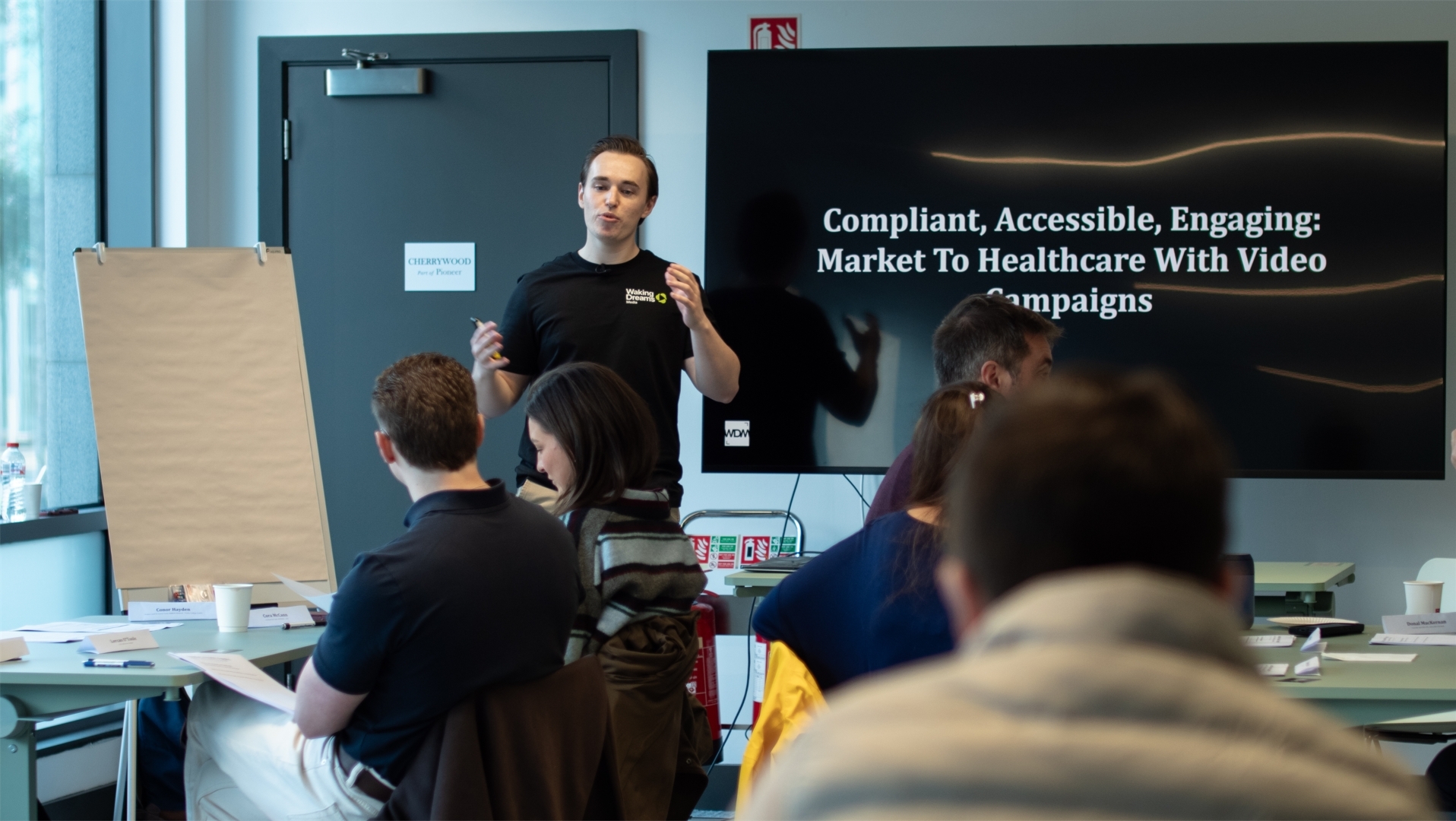
On 30 September we ran a half-day workshop at Pioneer Labs on the Cherrywood Campus in Dublin. The room was filled with founders, CEOs and marketing leads from healthtech, medtech and pharma companies. Each of them built a video campaign aimed at healthcare professionals (HCPs) and healthcare organisations (HCOs).
The material came from five years of client work. We’ve made videos for 90+ tech and life science companies, and about 1 in 3 of them sell into healthcare. Therese Lockwood (ex-Novartis Director of Product Management) led the GTM compliance section.
This article covers the three places healthcare campaigns go wrong, and the fix we taught for each.
At the end, you can download the full workbook and Therese’s Greenlight compliance checklist, free.
1. Find an unmet clinical need that’s real and ownable
Healthcare campaigns often stall before launch. In our experience, it usually comes down to one of these:
- There’s no true unmet need behind the message
- The product is positioned for the wrong stakeholder
- The campaign gets withdrawn for non-compliance
The fix is to position your product so it becomes famous for the one unmet need it solves.
Find the concern your buyers act on. Our client HaPPE Earth makes bioplastic aprons for hospitals. The team assumed price mattered most to hospital buyers. Procurement’s biggest fear turned out to be stock running out. Staff, sustainability officers and procurement each valued something different.
Map the job, then the owner. In the workshop, each team mapped the job their user is trying to get done, step by step. Then they named who owns that process inside the hospital, what they care about, and what switching would cost them.
Describe each step as the goal, not the tool. “Get the allergen into the skin” tells you more than “prick with a lancet”.
Write the desired outcome in their words. Use this format: when [situation], I want to [goal], so I can [outcome]. Leave your product out of it.
Check every claim before it goes in a script. Therese’s 30-second Greenlight asks five questions before you publish:
| Check | Question |
|---|---|
| Where | Which regulatory market will see this? |
| Who | Who is the intended viewer, and who could it realistically reach? |
| What | What exactly are you authorised to promote? |
| Prove | Can you substantiate every clinical and performance claim? |
| Protect | Are all required safety and regulatory notices present? |
Watch for red-flag words like safer, better, proven, reduces and clinically proven. Each one needs regulatory sign-off before you record the voiceover.

2. Get your story in front of HCPs and HCOs
A compliant story still needs an audience. Healthcare campaigns often make only a small splash because teams post the asset on the company LinkedIn and wait to see who finds it. Meanwhile, pharma and medtech own mainstream clinician attention and have a direct line.
Size your real audience first. Some participants were trying to influence only 10 or 20 clinicians nationwide. Broad social reach wastes most of its impressions at that size.
Go where clinicians already listen. In Wolters Kluwer’s 2026 study of 1,500+ US healthcare professionals, only 14% of physicians said they use social media to keep up to date in their speciality (This stat came from their webinar with Fierce Pharma). Health innovation networks, medical societies and professional bodies already hold your audience. One of their newsletters can reach your 20 target clinicians through a trusted source.
Send it direct. Our client HaPPE Earth sent our video directly to investors, customers and grant panels. Clinicians rarely come across start-ups, so put the video in front of the people who matter yourself. They’ve raised €800k+ and are now active in over 140 sites.

3. Design the video from your buying committee’s POV
Healthcare videos lose executives and procurement when they open on technical detail, or when the agency doesn’t understand how hospitals buy.
One strong product video comes first. Heidi, the AI scribe for clinicians, started with an explainer and a few product animations at seed stage. The customer stories, YouTube ads and quarterly commercial campaigns came after their Series A and later rounds.
Choose your main character carefully. Take a wearable monitoring tool for hospital patients. You could open on the patient sleeping through the night without being woken for checks. Or you could open on a nurse manager on a short-staffed shift, who gets an alert that the same patient is deteriorating. The nurse manager is likely your champion, so the second opening is the one that sells.
Lead with story, then science. HaPPE Earth’s video opens on “A plastic apron. A critical tool to prevent the spread of infection.” The bioplastic doesn’t appear until scene three. Mary O’Riordan, HaPPE’s founder, put it simply: innovators lead with the technical, and lose people.
I’m not a solicitor. Always run your concept, script and final cut past your regulatory and compliance team before anything goes live.
Get the workshop workbook and Greenlight checklist

The full workbook takes you through all 12 exercises, script, and storyboard frames we used on the day. It comes bundled with Therese Lockwood’s Greenlight Content Publishing Checklist, so you can check your messaging before it goes anywhere near a camera.
Work through it with one product and one job title. You’ll finish with an unmet need, a distribution plan and a first script.
Healthcare Content Publish Guidance 2026
If you’d like us to run it with your team, or want a spot in the next cohort, email luke@wakingdreamsmedia.com.
